
How to Increase Organic Traffic Without Increasing Ad Spend
Written by Vijay Mishra — Digital marketing consultant and trainer with 20+ years of hands-on experience in SEO, performance marketing, and content strategy. Vijay has led organic growth strategy for clients across automotive (OSL Prestige BMW), education (JBIHM), and D2C sectors. He writes from direct implementation experience, not theory.
Every time a client’s leads dip, the first question I get is: “Should we increase the ad budget?”
My answer, almost always, is no.
In 20 years of doing this — across automotive dealerships, hospitality institutes, D2C brands, and everything in between — I’ve seen more traffic growth come from fixing what’s already on the site than from pumping more money into ads. Ad spend buys you visibility while the meter is running. The moment you stop paying, the traffic stops. Organic traffic growth compounds. It’s still working for you at 2 AM while you’re asleep.
The problem isn’t that organic SEO doesn’t work anymore. The problem is that most websites are sitting on traffic they’ve already earned and are leaving on the table — old content nobody’s touched in two years, internal links that go nowhere, and zero visibility in the AI-generated answers that are increasingly where searches actually get resolved.
Here’s the framework I use with clients to boost their organic traffic and leads, with real examples from my own work.
Why “More Ad Spend” Is the Wrong Default Answer
Ad spend has a ceiling problem. You can only bid so aggressively before your cost-per-lead makes the campaign unprofitable, and in competitive categories — automotive, education, real estate — that ceiling arrives fast. I’ve worked with automotive dealership clients like OSL Prestige (BMW) where Google Ads costs-per-click in the luxury segment are steep enough that ad-driven lead generation alone was never going to scale sustainably. The sustainable lever was always going to be organic.
The same logic applied with JBIHM (JB Institute of Hospitality Management) — an education client where prospective students research extensively before enrolling. That research phase is almost entirely organic: Google searches, comparison content, and increasingly, AI-generated answers about “best hospitality institutes” or “hotel management courses after 12th.” If you’re not visible in that research phase, ad spend at the bottom of the funnel doesn’t save you.
So before recommending more budget, I ask three questions:
- Is the existing content actually competing for the right keywords, or has it decayed?
- Is the site’s internal architecture helping Google (and now AI engines) understand what pages matter?
- Is the content structured to be picked up and cited, not just ranked?
Those three questions map directly to the three levers below.
Lever 1: Content Refresh — Mining the Traffic You Already Earned
Every website with more than a year of content has pages that used to rank and have quietly slipped. This is the single highest-ROI activity I run for clients, and it costs nothing beyond time.
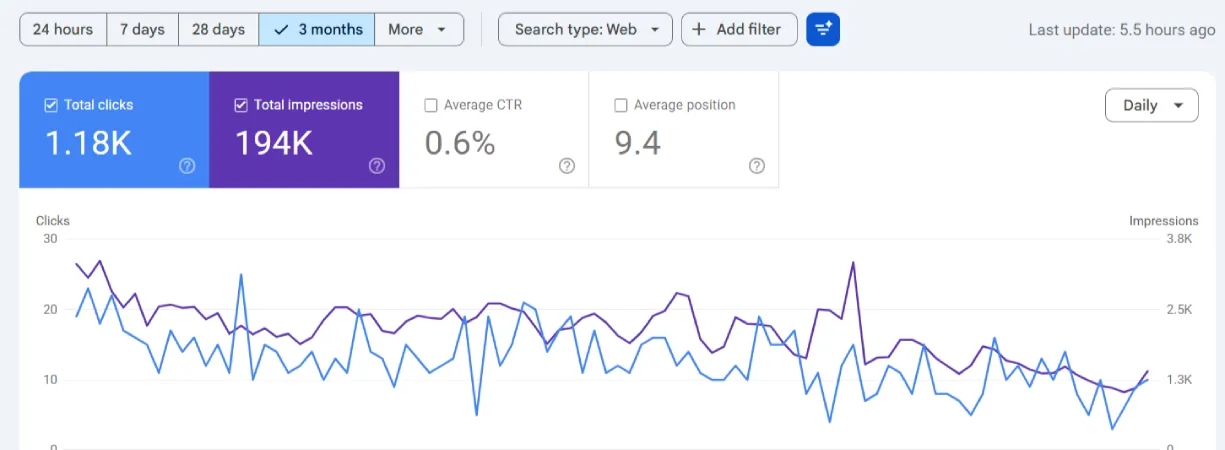
How I decide what to refresh first: I don’t guess. I go straight to Google Search Console.
The pages I prioritize are the ones showing a clear decline in traffic or ranking position over time — not pages that never ranked, and not pages performing fine. A page that used to sit in position 4 and has drifted to position 11 is telling you something specific: the content is still relevant enough to have earned that ranking once, but something has gone stale — either the information itself, the competing content has gotten better, or search intent has shifted since you wrote it.
This is a step I run manually for every client engagement — I don’t outsource it to an automated tool alone, because tools flag decline, but they don’t tell you why a specific page decayed. GSC’s performance data over a 12–16 month window tells you exactly where the decline started, which is often enough to diagnose the cause — a Google core update, a competitor publishing something more comprehensive, or the query intent evolving (informational queries slowly becoming transactional, for example).
What the refresh itself looks like:
- Rewrite for current search intent, not the intent that existed when the page was first published
- Update statistics, examples, and screenshots — stale data is one of the fastest ways to lose trust signals
- Expand thin sections that competitors have since out-depth’d
- Re-optimize the title tag and H1 based on current top-ranking pages for that query
- Add or update the publish date appropriately (not just cosmetically — only when the content has meaningfully changed)
For an automotive client like OSL Prestige, this meant regularly revisiting model-comparison and service content as new BMW models launched and search intent shifted from “features” to “price” to “test drive availability” across a buying cycle. For JBIHM, it meant refreshing course and career-outcome pages as the actual curriculum and placement data evolved year over year — content that goes stale silently is content that quietly stops converting.
The compounding effect here is real: a page recovering from position 11 to position 4 doesn’t just reclaim old traffic, it usually exceeds its previous peak, because you’re now also benefiting from improvements made everywhere else on the site since it first launched.
Lever 2: Internal Linking — Topic Clusters, Not Random Links
Most websites treat internal linking as an afterthought — a link here, a “related posts” widget there. I treat it as one of the most controllable ranking signals on the entire site, because unlike backlinks, you own 100% of it.
My method is the topic cluster / pillar-cluster model, and it works the same way whether the client is a dealership, an institute, or a personal brand.
The structure is simple:
- One pillar page targets a broad, high-volume topic (e.g., “BMW Buying Guide” or “Hotel Management Courses in India“)
- Multiple cluster pages each target a specific, narrower subtopic related to that pillar (e.g., “BMW 3 Series vs 5 Series,” “BMW Service Costs Explained,” or “Hotel Management vs Culinary Arts: Which to Choose”)
- Every cluster page links back to the pillar, and the pillar links out to every cluster page
- Cluster pages also link laterally to each other where genuinely relevant — not forced
What this does that random linking doesn’t: it tells Google exactly which page is the authority on a topic and funnels the ranking equity from all the supporting content into that one page, while the supporting pages themselves rank for their own long-tail variations. On OSL Prestige’s site, structuring model-specific and service-specific content this way meant the pillar buying-guide content consistently outranked competitors who had similar individual pages but no clear topical architecture tying them together.
I’ve also seen this go wrong — over-linking cluster pages to each other before the pillar itself has any authority just dilutes equity across the group instead of concentrating it. The pillar needs to earn its own ranking first; the cluster links are there to reinforce it, not substitute for it.
The practical rule I give clients: before publishing any new piece of content, ask which pillar it belongs to and link it in on day one. Retrofitting internal links onto years of orphaned content is a much bigger project than building the habit from the start.
Lever 3: AEO/GEO — Getting Cited, Not Just Ranked To Boost Organic Traffic
This is the lever most consultants still aren’t talking about, and it’s the one I’ve spent the most time on over the last two years.
Search behavior has changed. A meaningful share of queries now get resolved inside an AI Overview, a ChatGPT answer, or a Perplexity summary — before the person ever clicks through to a website. Ranking #1 in traditional blue links means less if the AI-generated answer above it has already satisfied the searcher using someone else’s content as the source.
Answer Engine Optimization (AEO) and Generative Engine Optimization (GEO) are about earning the citation inside that AI-generated answer, not just the click below it.
The single highest-leverage tactic I’ve used for this is structured data and schema markup. AI systems and Google’s own AI Overview feature rely heavily on structured, machine-readable signals to determine what a page is actually about and to extract quotable, attributable answers from it. Specifically:
- FAQPage schema on any content that answers direct questions — this maps almost one-to-one to how AI Overviews pull question-and-answer pairs
- Article and Organization schema to establish clear authorship and entity credibility, which matters increasingly for AI systems trying to assess source trustworthiness
- HowTo schema for process-based content, since step-by-step structured content is exactly the format generative engines prefer to extract and summarize
- Clear, direct-answer formatting in the actual copy — a concise, quotable definition or answer within the first 1–2 sentences of a section, before the elaboration — because that’s the sentence most likely to be lifted verbatim into an AI summary
For a service-based site like vijaymishra.in itself, this means structuring service pages so the “what is X” answer sits cleanly at the top of the section, tagged with the right schema, rather than buried under three paragraphs of preamble. For a client like JBIHM, it meant restructuring course-related FAQ content so it directly answered exactly what prospective students and parents were asking — “duration,” “eligibility,” “fees,” “placement record” — each as its own clearly marked, schema-tagged Q&A block instead of one long paragraph.
The mindset shift required here is important: you’re no longer only writing for a human scanning a page. You’re writing for a machine trying to extract a clean, attributable answer to hand to a human. Content that’s vague, meandering, or buries its answer under fluff simply doesn’t get picked up — regardless of how well it ranks traditionally.
Bringing It Together: The Framework in Practice
None of these three levers work in isolation, and that’s really the point of this post. A refreshed page with no internal links funneling authority to it will refresh slower than it should. A well-linked pillar page with content that isn’t structured for AEO/GEO will keep winning traditional rankings while losing the AI-answer visibility that’s increasingly where the traffic decision actually gets made.
The sequence I generally follow with clients:
- Audit in GSC to find declining pages — this is your refresh priority list
- Refresh the content, updating both substance and structure
- Slot it correctly into a topic cluster, linking it to its pillar and sibling pages
- Add appropriate schema markup and direct-answer formatting so it’s positioned to be cited, not just ranked
This is deliberately not a “quick win” framework. It’s slower than writing a check for more ad spend. But it’s also not renting traffic — it’s building an asset that keeps compounding long after the work is done, which is exactly why I keep recommending it over increased ad budgets, project after project, client after client.
If your organic traffic has plateaued, the honest first question isn’t “how much more should we spend on ads” — it’s “when did we last actually look at what’s already published.”
